انجیسی ۶۷۶
| انجیسی ۶۷۶ | |
|---|---|
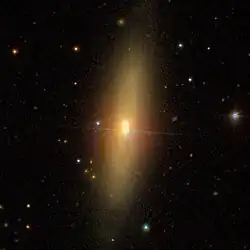 NGC 676 galaxy seen by نقشهبرداری آسمانی دیجیتال اسلون. Diffraction spike are due to the star نظرسنجی بن +04 0244, superposed on the nucleus.[۱] | |
| اطلاعات رصدی (مبدأ مبدا) | |
| صورت فلکی | ماهی |
| بُعد | 01h 48m 57.3148s[۲] |
| مِیل | 27.082″ 54′ +05°[۲] |
| انتقال به سرخ | 0.005023[۲][۳] |
| فاصله | ۱۸٫۷ مگاپارسک (۶۱ مگا سال نوری)[۲] |
| قدر ظاهری (V) | 10.5 +/- 0.4[۴] |
| ویژگیها | |
| گونه | S0/a: edge-on[۲] |
| اندازه | ~۸۸٬۷۰۰ سال نوری (۲۷٫۲۰ کیلوپارسک) (estimated)[۲] |
| اندازه ظاهری (V) | 4.0′ × 1.2′[۲] |
| نامهای دیگر | |
| Ark 057[۵]، UGC ۱۲۷۰، MCG+۰۱-۰۵-۰۳۴، PGC 6656[۲] | |
انجیسی ۶۷۶ (انگلیسی: NGC 676) یک کهکشان عدسی شکل[۶] در صورت فلکی حوت است.[۷] این کهکشان توسط ستارهشناس آلمانی-بریتانیایی ویلیام هرشل در ۳۰ سپتامبر ۱۷۸۶ کشف شد.[۸]
جستارهای وابسته
منابع
- ↑ Nemiroff, Robert; Bonnell, Jerry (15 April 2001). "Diffraction Spikes: When Stars Look Like Crosses". Astronomy Photo of the Day. Astrophysics Science Division at NASA. Retrieved 26 August 2020.
Unusual appendages around bright stars are commonplace, but never seem to be mentioned. What are they? First, a telescope brings starlight falling over a large area to a small area. To get at this small area, however, one must go inside a reflecting telescope, and one good way to do this is to use support rods, which are right in the view of the telescope. The wave nature of light causes it to deflect when passing near these rods. Light scatters away from the original destination point ending up elsewhere and appearing as "diffraction spikes". These annoying spikes steal precious light from the central image and hide light from fainter, more interesting stars.
- 1 2 3 4 5 6 7 8 "NASA/IPAC Extragalactic Database". Results for NGC 676. Retrieved 22 August 2020.
- ↑ Paturel, G; Dubois, P; Petit, C; Woelfel, F (January 2002). "Comparison LEDA/SIMBAD". LEDA. Bibcode:2002LEDA.........0P. Retrieved 24 August 2020.
- ↑ "NGC 676". SIMBAD. The Centre de Données Astronomiques de Strasbourg (CDS). Retrieved 23 August 2020.
- ↑ Arakelian, Marat (January 1975). "The Galaxies of High Surface Brightness". Communications of the Byurakan Astrophysical Observatory. 47: 3–42. Bibcode:1975CoBAO..47....3A. Retrieved 25 August 2020.
- ↑ "NGC 676 - Lenticular Galaxy". TheSkyLive.com. Retrieved 23 August 2020.
- ↑ "Distance Results for NGC 676". NASA/IPAC EXTRAGALACTIC DATABASE. NASA. Retrieved 14 November 2024.
- ↑ Seligman, Courtney. "NGC 676". Celestial Atlas. Retrieved 14 November 2024.
- مشارکتکنندگان ویکیپدیا. «NGC 676». در دانشنامهٔ ویکیپدیای انگلیسی، بازبینیشده در ۳۱ مه ۲۰۲۶.
پیوند به بیرون

در ویکیانبار پروندههایی دربارهٔ انجیسی ۶۷۶ موجود است.
ردهها:
- اجرام آسمانی کشفشده در سال ۱۷۸۶ (میلادی)
- اجرام انجیسی
- اجرام پیجیسی
- اجرام یوجیسی
- صورت فلکی ماهی
- کهکشانهای عدسی