ریاضیات در هند
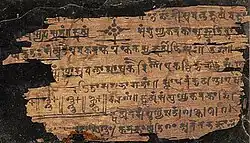
ریاضیات در شبهقاره هند[۱] از ۱۲۰۰ پیش از میلاد[۲] ظاهر شد و تا انتهای قرن هجدهم ادامه یافت. در دوره کلاسیک ریاضیات هند (۴۰۰ تا ۱۲۰۰ میلادی) کارهای مهمی توسط دانشورانی مثل آریابهاتا، برهماگوپتا، باسکارا دوم، واراهامیهیرا و مادهاوا انجام شد. سیستم عددی دهدهی که امروز استفاده میگردد،[۳] اولین بار در ریاضیات هند ثبت شد.[۴] ریاضیدانان هندی کارهای اولیهای در بررسی مفهوم صفر به عنوان یک عدد،[۵] اعداد منفی،[۶] حساب و جبر انجام دادند.[۷] بهعلاوه، مثلثات[۸] پیشرفتهای بیشتری در هند دید و بهویژه تعاریف امروزی سینوس و کسینوس در آنجا شکل داده شد.[۹] این مفاهیم ریاضیاتی به خاورمیانه، چین و اروپا کشیده شدند.[۷]
جستارهای وابسته
پانویس
- ↑ (Kim Plofker 2007, p. 1)
- ↑ (Hayashi 2005, pp. 360–361)
- ↑ (Ifrah 2000, p. 346): "The measure of the genius of Indian civilisation, to which we owe our modern (number) system, is all the greater in that it was the only one in all history to have achieved this triumph. Some cultures succeeded, earlier than the Indian, in discovering one or at best two of the characteristics of this intellectual feat. But none of them managed to bring together into a complete and coherent system the necessary and sufficient conditions for a number-system with the same potential as our own."
- ↑ (Plofker 2009, pp. 44–47)
- ↑ (Bourbaki 1998, p. 46): "...our decimal system, which (by the agency of the Arabs) is derived from Hindu mathematics, where its use is attested already from the first centuries of our era. It must be noted moreover that the conception of zero as a number and not as a simple symbol of separation) and its introduction into calculations, also count amongst the original contribution of the Hindus."
- ↑ (Bourbaki 1998, p. 49): Modern arithmetic was known during medieval times as "Modus Indorum" or method of the Indians. Leonardo of Pisa wrote that compared to method of the Indians all other methods is a mistake. This method of the Indians is none other than our very simple arithmetic of addition, subtraction, multiplication and division. Rules for these four simple procedures was first written down by Brahmagupta during the 7th century AD. "On this point, the Hindus are already conscious of the interpretation that negative numbers must have in certain cases (a debt in a commercial problem, for instance). In the following centuries, as there is a diffusion into the West (by intermediary of the Arabs) of the methods and results of Greek and Hindu mathematics, one becomes more used to the handling of these numbers, and one begins to have other "representation" for them which are geometric or dynamic."
- 1 2 "algebra" 2007. Britannica Concise Encyclopedia بایگانیشده در ۲۹ سپتامبر ۲۰۰۷ توسط Wayback Machine. Encyclopædia Britannica Online. 16 May 2007. Quote: "A full-fledged decimal, positional system certainly existed in India by the 9th century (AD), yet many of its central ideas had been transmitted well before that time to China and the Islamic world. Indian arithmetic, moreover, developed consistent and correct rules for operating with positive and negative numbers and for treating zero like any other number, even in problematic contexts such as division. Several hundred years passed before European mathematicians fully integrated such ideas into the developing discipline of algebra."
- ↑ (Pingree 2003, p. 45) Quote: "Geometry, and its branch trigonometry, was the mathematics Indian astronomers used most frequently. Greek mathematicians used the full chord and never imagined the half chord that we use today. Half chord was first used by Aryabhata which made trigonometry much more simple. In fact, the Indian astronomers in the third or fourth century, using a pre-Ptolemaic Greek table of chords, produced tables of sines and versines, from which it was trivial to derive cosines. This new system of trigonometry, produced in India, was transmitted to the Arabs in the late eighth century and by them, in an expanded form, to the Latin West and the Byzantine East in the twelfth century."
- ↑ (Bourbaki 1998, p. 126): "As for trigonometry, it is disdained by geometers and abandoned to surveyors and astronomers; it is these latter (Aristarchus, Hipparchus, Ptolemy) who establish the fundamental relations between the sides and angles of a right angled triangle (plane or spherical) and draw up the first tables (they consist of tables giving the chord of the arc cut out by an angle on a circle of radius r, in other words the number ; the introduction of the sine, more easily handled, is due to Hindu mathematicians of the Middle Ages)."


منابع
- Bourbaki, Nicolas (1998), Elements of the History of Mathematics, Berlin, Heidelberg, and New York: Springer-Verlag, 301 pages, ISBN 978-3-540-64767-6.
- Boyer, C. B.; Merzback (fwd. by Isaac Asimov), U. C. (1991), History of Mathematics, New York: John Wiley and Sons, 736 pages, ISBN 978-0-471-54397-8.
- Bressoud, David (2002), "Was Calculus Invented in India?", The College Mathematics Journal, 33 (1): 2–13, doi:10.2307/1558972, JSTOR 1558972.
- Bronkhorst, Johannes (2001), "Panini and Euclid: Reflections on Indian Geometry", Journal of Indian Philosophy, 29 (1–2), Springer Netherlands: 43–80, doi:10.1023/A:1017506118885, S2CID 115779583.
- Burnett, Charles (2006), "The Semantics of Indian Numerals in Arabic, Greek and Latin", Journal of Indian Philosophy, 34 (1–2), Springer-Netherlands: 15–30, doi:10.1007/s10781-005-8153-z, S2CID 170783929.
- Burton, David M. (1997), The History of Mathematics: An Introduction, The McGraw-Hill Companies, Inc., pp. 193–220.
- Cooke, Roger (2005), The History of Mathematics: A Brief Course, New York: Wiley-Interscience, 632 pages, ISBN 978-0-471-44459-6.
- Dani, S. G. (25 July 2003), "On the Pythagorean triples in the Śulvasūtras" (PDF), Current Science, 85 (2): 219–224, archived from the original (PDF) on 4 August 2003.
- Datta, Bibhutibhusan (December 1931), "Early Literary Evidence of the Use of the Zero in India", The American Mathematical Monthly, 38 (10): 566–572, doi:10.2307/2301384, JSTOR 2301384.
- Datta, Bibhutibhusan; Singh, Avadesh Narayan (1962), History of Hindu Mathematics : A source book, Bombay: Asia Publishing House
{{یادکرد}}: نگهداری یادکرد:مکان ناشر (رده). - De Young, Gregg (1995), "Euclidean Geometry in the Mathematical Tradition of Islamic India", Historia Mathematica, 22 (2): 138–153, doi:10.1006/hmat.1995.1014.
- Kim Plofker (2007), "mathematics, South Asian", Encyclopaedia Britannica Online, pp. 1–12, retrieved 18 May 2007.
- Filliozat, Pierre-Sylvain (2004), "Ancient Sanskrit Mathematics: An Oral Tradition and a Written Literature", in Chemla, Karine; Cohen, Robert S.; Renn, Jürgen; et al. (eds.), History of Science, History of Text (Boston Series in the Philosophy of Science), Dordrecht: Springer Netherlands, 254 pages, pp. 137–157, pp. 360–375, doi:10.1007/1-4020-2321-9_7, ISBN 978-1-4020-2320-0.
- Fowler, David (1996), "Binomial Coefficient Function", The American Mathematical Monthly, 103 (1): 1–17, doi:10.2307/2975209, JSTOR 2975209.
- Hayashi, Takao (1995), The Bakhshali Manuscript, An ancient Indian mathematical treatise, Groningen: Egbert Forsten, 596 pages, ISBN 978-90-6980-087-5.
- Hayashi, Takao (1997), "Aryabhata's Rule and Table of Sine-Differences", Historia Mathematica, 24 (4): 396–406, doi:10.1006/hmat.1997.2160.
- Hayashi, Takao (2003), "Indian Mathematics", in Grattan-Guinness, Ivor (ed.), Companion Encyclopedia of the History and Philosophy of the Mathematical Sciences, vol. 1, Baltimore, MD: The Johns Hopkins University Press, pp. 118–130, ISBN 978-0-8018-7396-6.
- Hayashi, Takao (2005), "Indian Mathematics", in Flood, Gavin (ed.), The Blackwell Companion to Hinduism, Oxford: Basil Blackwell, 616 pages, pp. 360–375, pp. 360–375, ISBN 978-1-4051-3251-0.
- Henderson, David W. (2000), "Square roots in the Sulba Sutras", in Gorini, Catherine A. (ed.), Geometry at Work: Papers in Applied Geometry, vol. 53, Washington DC: Mathematical Association of America Notes, pp. 39–45, ISBN 978-0-88385-164-7.
- Ifrah, Georges (2000). A Universal History of Numbers: From Prehistory to Computers. New York: Wiley. ISBN 0471393401.
- Joseph, G. G. (2000), The Crest of the Peacock: The Non-European Roots of Mathematics, Princeton, NJ: Princeton University Press, 416 pages, ISBN 978-0-691-00659-8.
- Katz, Victor J. (1995), "Ideas of Calculus in Islam and India", Mathematics Magazine, 68 (3): 163–174, doi:10.2307/2691411, JSTOR 2691411.
- Katz, Victor J., ed. (2007), The Mathematics of Egypt, Mesopotamia, China, India, and Islam: A Sourcebook, Princeton, NJ: Princeton University Press, pp. 385–514, ISBN 978-0-691-11485-9.
- Keller, Agathe (2005), "Making diagrams speak, in Bhāskara I's commentary on the Aryabhaṭīya" (PDF), Historia Mathematica, 32 (3): 275–302, doi:10.1016/j.hm.2004.09.001.
- Kichenassamy, Satynad (2006), "Baudhāyana's rule for the quadrature of the circle", Historia Mathematica, 33 (2): 149–183, doi:10.1016/j.hm.2005.05.001.
- Neugebauer, Otto; Pingree, David, eds. (1970), The Pañcasiddhāntikā of Varāhamihira, Copenhagen
{{یادکرد}}: نگهداری یادکرد:مکان بدون ناشر (رده). New edition with translation and commentary, (2 Vols.). - Pingree, David (1971), "On the Greek Origin of the Indian Planetary Model Employing a Double Epicycle", Journal of Historical Astronomy, 2 (1): 80–85, Bibcode:1971JHA.....2...80P, doi:10.1177/002182867100200202, S2CID 118053453.
- Pingree, David (1973), "The Mesopotamian Origin of Early Indian Mathematical Astronomy", Journal of Historical Astronomy, 4 (1): 1–12, Bibcode:1973JHA.....4....1P, doi:10.1177/002182867300400102, S2CID 125228353.
- Pingree, David, ed. (1978), The Yavanajātaka of Sphujidhvaja, Harvard Oriental Series 48 (2 vols.), Edited, translated and commented by D. Pingree, Cambridge, MA
{{یادکرد}}: نگهداری یادکرد:مکان بدون ناشر (رده). - Pingree, David (1988), "Reviewed Work(s): The Fidelity of Oral Tradition and the Origins of Science by Frits Staal", Journal of the American Oriental Society, 108 (4): 637–638, doi:10.2307/603154, JSTOR 603154.
- Pingree, David (1992), "Hellenophilia versus the History of Science", Isis, 83 (4): 554–563, Bibcode:1992Isis...83..554P, doi:10.1086/356288, JSTOR 234257, S2CID 68570164
- Pingree, David (2003), "The logic of non-Western science: mathematical discoveries in medieval India", Daedalus, 132 (4): 45–54, doi:10.1162/001152603771338779, S2CID 57559157.
- Plofker, Kim (1996), "An Example of the Secant Method of Iterative Approximation in a Fifteenth-Century Sanskrit Text", Historia Mathematica, 23 (3): 246–256, doi:10.1006/hmat.1996.0026.
- Plofker, Kim (2001), "The "Error" in the Indian "Taylor Series Approximation" to the Sine", Historia Mathematica, 28 (4): 283–295, doi:10.1006/hmat.2001.2331.
- Plofker, K. (2007), "Mathematics of India", in Katz, Victor J. (ed.), The Mathematics of Egypt, Mesopotamia, China, India, and Islam: A Sourcebook, Princeton, NJ: Princeton University Press, pp. 385–514, ISBN 978-0-691-11485-9.
- Plofker, Kim (2009), Mathematics in India: 500 BCE–1800 CE, Princeton, NJ: Princeton University Press, ISBN 978-0-691-12067-6.
- Price, John F. (2000), "Applied geometry of the Sulba Sutras" (PDF), in Gorini, Catherine A. (ed.), Geometry at Work: Papers in Applied Geometry, vol. 53, Washington DC: Mathematical Association of America Notes, pp. 46–58, ISBN 978-0-88385-164-7, archived from the original (PDF) on 27 September 2007, retrieved 20 May 2007.
- Roy, Ranjan (1990), "Discovery of the Series Formula for by Leibniz, Gregory, and Nilakantha", Mathematics Magazine, 63 (5): 291–306, doi:10.2307/2690896, JSTOR 2690896.
- Singh, A. N. (1936), "On the Use of Series in Hindu Mathematics", Osiris, 1 (1): 606–628, doi:10.1086/368443, JSTOR 301627, S2CID 144760421
- Staal, Frits (1986), "The Fidelity of Oral Tradition and the Origins of Science", Mededelingen der Koninklijke Nederlandse Akademie von Wetenschappen, Afd. Letterkunde, New Series, 49 (8), Amsterdam: North Holland Publishing Company.
- Staal, Frits (1995), "The Sanskrit of science", Journal of Indian Philosophy, 23 (1), Springer Netherlands: 73–127, doi:10.1007/BF01062067, S2CID 170755274.
- Staal, Frits (1999), "Greek and Vedic Geometry", Journal of Indian Philosophy, 27 (1–2): 105–127, doi:10.1023/A:1004364417713, S2CID 170894641.
- Staal, Frits (2001), "Squares and oblongs in the Veda", Journal of Indian Philosophy, 29 (1–2), Springer Netherlands: 256–272, doi:10.1023/A:1017527129520, S2CID 170403804.
- Staal, Frits (2006), "Artificial Languages Across Sciences and Civilisations", Journal of Indian Philosophy, 34 (1), Springer Netherlands: 89–141, doi:10.1007/s10781-005-8189-0, S2CID 170968871.
- Stillwell, John (2004), Mathematics and its History, Undergraduate Texts in Mathematics (2 ed.), Springer, Berlin and New York, 568 pages, doi:10.1007/978-1-4684-9281-1, ISBN 978-0-387-95336-6.
- Thibaut, George (1984) [1875], Mathematics in the Making in Ancient India: reprints of 'On the Sulvasutras' and 'Baudhyayana Sulva-sutra', Calcutta and Delhi: K. P. Bagchi and Company (orig. Journal of the Asiatic Society of Bengal), 133 pages.
- van der Waerden, B. L. (1983), Geometry and Algebra in Ancient Civilisations, Berlin and New York: Springer, 223 pages, ISBN 978-0-387-12159-8
- van der Waerden, B. L. (1988), "On the Romaka-Siddhānta", Archive for History of Exact Sciences, 38 (1): 1–11, doi:10.1007/BF00329976, S2CID 189788738
- van der Waerden, B. L. (1988), "Reconstruction of a Greek table of chords", Archive for History of Exact Sciences, 38 (1): 23–38, Bibcode:1988AHES...38...23V, doi:10.1007/BF00329978, S2CID 189793547
- Van Nooten, B. (1993), "Binary numbers in Indian antiquity", Journal of Indian Philosophy, 21 (1), Springer Netherlands: 31–50, doi:10.1007/BF01092744, S2CID 171039636
- Whish, Charles (1835), "On the Hindú Quadrature of the Circle, and the infinite Series of the proportion of the circumference to the diameter exhibited in the four S'ástras, the Tantra Sangraham, Yucti Bháshá, Carana Padhati, and Sadratnamála", Transactions of the Royal Asiatic Society of Great Britain and Ireland, 3 (3): 509–523, doi:10.1017/S0950473700001221, JSTOR 25581775
- Yano, Michio (2006), "Oral and Written Transmission of the Exact Sciences in Sanskrit", Journal of Indian Philosophy, 34 (1–2), Springer Netherlands: 143–160, doi:10.1007/s10781-005-8175-6, S2CID 170679879

پیوند به بیرون

در ویکیانبار پروندههایی دربارهٔ ریاضیات در هند موجود است.
ردهها:
- ریاضیات هند
- علم و فناوری در هند