هوا تو
هوا تو 華佗 | |
|---|---|
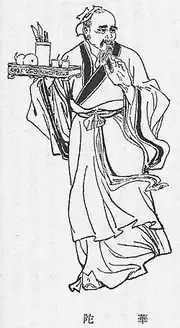 تصویری از هوا تو در یک نگارهٔ دورهٔ دودمان چینگ | |
| زادهٔ | ح. ۱۴۰[۱] |
| درگذشت | ۲۰۸ (۶۸ سال)[۱] |
| دیگر نامها | یوانهوا (元化) |
| پیشه | پزشک |
| Hua Tuo | |||||||
| نویسههای چینی سنتی | 華佗 | ||||||
|---|---|---|---|---|---|---|---|
| نویسههای چینی سادهشده | 华佗 | ||||||
| |||||||
| Yuanhua | |||||||
| زبانهای چینی | 元化 | ||||||
| |||||||
هوا تو (انگلیسی: Hua Tuo؛ حدود ۱۴۰–۲۰۸ میلادی) با نام محترم یوانهوا، پزشک چینی در اواخر دورهٔ دودمان هان شرقی بود.[۱] بر پایهٔ منابع تاریخی همچون تاریخ سه پادشاهی و تاریخ هان متاخر، هوا تو نخستین فرد در چین بهشمار میرود که در جراحی از بیهوشی استفاده کرد. او نوعی بیهوشکنندهٔ عمومی به کار میبرد که از ترکیب شراب با دارویی گیاهی به نام مافِیسان (麻沸散؛ به معنای تحتاللفظی «پودر جوشانِ شاهدانه») تهیه میشد. هوا تو افزون بر مهارت در جراحی و بیهوشی، به سبب تواناییهایش در طب سوزنی، فتیلهگذاری، گیاهدرمانی و تمرینهای درمانی دائویین نیز شهرت داشت. او با الهام از حرکات ببر، گوزن، خرس، میمون و درنا، مجموعهای از تمرینهای بدنی به نام ووچینشی (五禽戲؛ بهمعنای «تمرین پنج جانور») را ابداع کرد.
منابع
- 1 2 3 de Crespigny (2007), p. 332.
- Chen, Jinhua (2007). Philosopher, Practitioner, Politician: The Many Lives of Fazang (643-712). Brill.
- Chen, Shou (c. 200s). Records of the Three Kingdoms (in Chinese). Vol. 29.
- Chen, Yinque (1977). Biographies of Cao Chong and Hua Tuo in the Sanguozhi and their relationship with Buddhist legends (in Chinese). Jiushi chuban.
- de Crespigny, Rafe (2007). A biographical dictionary of Later Han to the Three Kingdoms (23–220 AD). Leiden: Brill. ISBN 978-90-04-15605-0.
- DeWoskin, Kenneth J. (1983). Doctors, Diviners and Magicians of Ancient China: Biographies of Fang-Shih. Columbia University Press.
- Fan, Ka Wai (2004). "On Hua Tuo's Position in the History of Chinese Medicine". The American Journal of Chinese Medicine. 32 (2): 313–320. doi:10.1142/S0192415X04001965. PMID 15315268.
- Fan, Ye (c. 400s). Book of the Later Han (in Chinese). Vol. 82.
- Giles, Herbert A. (1897). A Chinese Biographical Dictionary. Kelly & Walsh.
- Giles, Lionel (1912). Taoist Teachings from the Book of Lieh-Tzŭ. Wisdom of the East.
- Giles, Lionel (1948). A Gallery of Chinese Immortals. J. Murray.
- Li, Hui-Lin (1974). "The Origin and Use of Cannabis in Eastern Asia: Linguistic-Cultural Implications". Economic Botany. 28 (3): 293–301. Bibcode:1974EcBot..28..293L. doi:10.1007/bf02861426. S2CID 31817755.
- Lu, Gwei-Djen; Needham, Joseph (2002). Celestial Lancets: A History and Rationale of Acupuncture and Moxa. Routledge.
- Mair, Victor H. (1994). "The Biography of Hua-t'o from the "History of the Three Kingdoms"". In Victor H. Mair (ed.). The Columbia Anthology of Traditional Chinese Literature. Columbia University Press. pp. 688–696.
- Salguero, C. Pierce (2009). "The Buddhist medicine king in literary context: reconsidering an early medieval example of Indian influence on Chinese medicine and surgery". History of Religions. 48 (3): 183–210. doi:10.1086/598230. S2CID 162211011.
- Schuessler, Axel (2007). An Etymological Dictionary of Old Chinese. University of Hawaii Press.
- Smith, Frederick P (1871). Contributions towards the Materia Medica and Natural History of China. Trubner & Co.
- Veith, Ilza (1966). Huang Ti Nei Ching Su Wen; The Yellow Emperor's Classic of Internal Medicine. University of California Press.
- Wang, Zhenguo; Chen, Ping (1999). History and Development of Traditional Chinese Medicine. IOS Press.
پیوند به بیرون

در ویکیانبار پروندههایی دربارهٔ هوا تو موجود است.
- Hua Tuo, Subhuti Dharmananda
- Hua Tuo: A miraculous healer in ancient China بایگانیشده در ۲۰۱۰-۱۲-۲۲ توسط Wayback Machine, Association for Asian Research
- A Brief Biography of Hua Tuo, John Chen
- Shifu Alan Tinnion - Five Animal Frolics Hua Tuo Nei Gong 華 佗 內 功
ردهها:
- اهالی بوجوا
- اهالی دودمان هان مرتبط با سه پادشاهی
- چی کونگ
- خدایان سلامتی