عصر برنز نوردیک
 | |
| مکان | جنوب اسکاندیناوی، شمال آلمان |
|---|---|
| دوران | عصر برنز |
| تاریخها | ح. ۲۰۰۰/۱۷۵۰–۵۰۰ پیش از میلاد |
| پس از | فرهنگ پیاله ناقوسی، عصر حجر نوردیک |
| بخشی از مجموعهای در |
| اسکاندیناوی |
|---|
 |
عصر برنز نوردیک (همچنین عصر برنز شمالی یا عصر برنز اسکاندیناوی) دورهای از پیشاتاریخ اسکاندیناوی است که از سال ۲۰۰۰ یا ۱۷۵۰ تا ۵۰۰ پیش از میلاد ادامه داشت.
فرهنگ عصر برنز نوردیک در دورهٔ زمانی سال ۲۰۰۰ تا ۱۷۵۰ پیش از میلاد به عنوان ادامهای از دوران خنجرِ نوسنگی متأخر شکل گرفت که ریشه در فرهنگ تبر جنگی، فرهنگ گور تک و فرهنگ پیاله ناقوسی و همچنین تأثیراتی از اروپای مرکزی دارد.[۱][۲][۳] این تأثیر احتمالاً از مردمانی مشابه با فرهنگ اونتیتسه آمد، زیرا آنها آداب و رسومی را با خود آوردند که از اونتیتسه یا از تفاسیر محلی فرهنگ اونتیتسه واقع در شمال غربی آلمان گرفته شده است.[۴] تأثیرات فلزکاری از اروپای مرکزی نیز بهطور ویژهای قابلتوجهاند.[۵][۶] گفته میشود عصر برنز در اسکاندیناوی در بازهٔ زمانی کوتاهی پس از ۲۰۰۰ پیشازمیلاد با ابداع و بهکارگیری ابزارهای برنزی آغاز شد و از سال ۱۷۵۰ پیشازمیلاد اقتباسی قاعدهدارتر از فلزکاری برنز انجام شد.[۷][۸][۹][۱۰][۱۱]
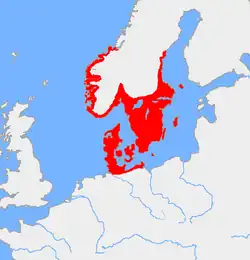
عصر برنز نوردیک پیوندهای تجاری نزدیکی با یونان میسنی داشت و با هم شباهتهای چشمگیری دارند.[۱۲][۱۳] برخی شباهتها میان عصر برنز نوردیک با فرهنگهای سینتاشتا/آندرونوو و مردمان ریگودا نیز تشخیص داده شدهاند.[۱۴] منطقهٔ عصر برنز نوردیک شامل بخشی از شمال آلمان میشد،[۱۵] برخی از پژوهشگران نیز مکانهایی در سرزمینهای امروزی استونی، فنلاند و پومرانی را بخشی از کانون تمدن و فرهنگ آن میدانند.[۱۶][۱۷]
مردم عصر برنز نوردیک بهطور فعال در صادرات کهربا مشارکت میکردند و در عوض فلز وارد میکردند. در نتیجه، آنها فلزکاران ماهری شدند. با توجه به تعداد و تراکم رسوبات فلزی، عصر برنز نوردیک در طول حیات خود به ثروتمندترین فرهنگ اروپا تبدیل شد.[۱۸]
منابع
- ↑ Kristiansen, Kristian; Larsson, Thomas B. (2005). The Rise of Bronze Age Society. Cambridge University Press. p. 141. ISBN 978-0-521-84363-8. Archived from the original on 29 March 2023. Retrieved 21 December 2021.
The Early Bronze Age societies that evolved after 2000 BC thus inherited their basic social and cosmological order from the Beaker and Battle-Axe cultures of the third millennium BC.
- ↑ Vandkilde, Helle (April 2014). "Breakthrough of the Nordic Bronze Age: Transcultural Warriorhood and a Carpathian Crossroad in the Sixteenth Century BC". European Journal of Archaeology. 17 (4): 602–633. doi:10.1179/1461957114Y.0000000064. S2CID 162256646. Archived from the original on 22 July 2022. Retrieved 30 November 2020.
- ↑ Kristiansen, Kristian (2009). "Proto-Indo-European Languages and Institutions: An Archaeological Approach". In van der Linden, M.; Jones-Bley, C. (eds.). Journal of Indo-European Studies Monograph Series, No. 56: Departure from the Homeland. pp. 111–140. Archived from the original on 29 September 2022. Retrieved 2 May 2023.
- ↑ Johannsen, Jens (2017). "Mansion on the Hill – A Monumental Late Neolithic House at Vinge, Zealand, Denmark". Journal of Neolithic Archaeology. 19. Archived from the original on 20 April 2023. Retrieved 2 May 2023.
- ↑ Ling, Johan; Persson, Per-Olof; Billström, Kjell (14 March 2013). "Moving metals II: provenancing Scandinavian Bronze Age artefacts by lead isotope and elemental analyses" (PDF). Journal of Archaeological Science. 41: 107–129. Bibcode:2014JArSc..41..106L. doi:10.1016/j.jas.2013.07.018. Archived (PDF) from the original on 23 March 2022. Retrieved 30 November 2020 – via shfa.se.
- ↑ Bergerbrant, Sophie (May 2007). "Bronze Age Identities: Costume, Conflict and Contact in Northern Europe 1600–1300 BC" (PDF). Stockholm Studies in Archaeology (43): 7–201. Archived (PDF) from the original on 10 July 2022. Retrieved 30 November 2020 – via diva-portal.org.
- ↑ Vandkilde, Helle (2004). "Bronze Age Scandinavia". In Bogucki, Peter; Crabtree, Pam J. (eds.). Ancient Europe, 8000 B.C. to A.D. 1000: Encyclopedia of the Barbarian World. Charles Scribner's Sons. p. 73. ISBN 0-684-80668-1.
The Bronze Age proper commenced c. 1700 B.C. and concluded c. 500 B.C. , but metals became socially integrated by about 2000 B.C. , during the Late Neolithic period—already a bronze age in all but name.
- ↑ Nørgaard, HW; Pernicka, E; Vandkilde, H (2019). "On the trail of Scandinavia's early metallurgy: Provenance, transfer and mixing". PLOS ONE. 14 (7): e0219574. Bibcode:2019PLoSO..1419574N. doi:10.1371/journal.pone.0219574. PMC 6655661. PMID 31339904.
As early as c. 4400 BC, there are signs of a faint awareness of copper technologies in Scandinavia in the form of rare imports of copper axes into the region's Late Mesolithic communities. A thousand years later, local metallurgy was likely practiced in the Middle Neolithic Funnelbeaker culture, only to disappear again subsequently. During most of the third millennium, metallurgy seems absent from the region, even if experiments with casting copper axes and hammering sheet ornaments reappear in Bell Beaker environments in Jutland, 2400–2100 BC. … At 2000 BC, however, a copper-based technology begins to achieve full economic and social integration in Scandinavia simultaneously with the spread of bronze, or copper with similar properties, across Europe
- ↑ Brozio, Jan Piet; Stos-Gale, Zofia; Müller, Johannes; Müller-Scheeßel, Nils; Schultrich, Sebastian; Fritsch, Barbara; Jürgens, Fritz; Skorna, Henry (2023-05-10). "The origin of Neolithic copper on the central Northern European plain and in Southern Scandinavia: Connectivities on a European scale". PLOS ONE (به انگلیسی). 18 (5): e0283007. Bibcode:2023PLoSO..1883007B. doi:10.1371/journal.pone.0283007. ISSN 1932-6203. PMC 10171686. PMID 37163484.
- ↑ Williams, R. Alan; et al. (2025). "From Land's End to the Levant: did Britain's tin sources transform the Bronze Age in Europe and the Mediterranean?". Antiquity: 1–19. doi:10.15184/aqy.2025.41.
a remarkable change occurred in the period c. 2200–2100 BC when Britain was the first region in Europe to completely switch all metalwork from (arsenical) copper to full tin-bronze (typically 10% tin). This full adoption or ‘bronzization’ subsequently occurred across Scandinavia and Central Europe by around 1800 BC and finally in southern Iberia, the Aegean and Egypt by around 1500/1300 BC
- ↑ Kristiansen, Kristian (2010). "Decentralized Complexity: The Case of Bronze Age Northern Europe". Pathways to Power. Fundamental Issues in Archaeology. Springer, New York, NY. pp. 169–192. doi:10.1007/978-1-4419-6300-0_7. ISBN 978-1-4419-6299-7. Archived from the original on 5 April 2023. Retrieved 26 September 2022.
The northern Bronze Age may be said to begin shortly after 2000 BC with the introduction and use of simple bronze tools, especially axes. At the same time, huge longhouses for large (chiefly) households emerged. With the more systematic adoption of metalworking bronze technology after 1750 BC, a diversified use of new tools, weapons, and ornaments made of bronze appeared, together with a new warrior elite.
- ↑ Kristiansen, Kristian; Larsson, Thomas B. (2005). The Rise of Bronze Age Society. Cambridge University Press. p. 342. ISBN 978-0-521-84363-8. Archived from the original on 29 March 2023. Retrieved 21 December 2021.
In the Nordic Bronze Age of period 2 one finds more east Mediterranean and Mycenaean influences in metalwork, prestige goods and cosmology than in any other region in Europe.
- ↑ Vandkilde, Helle (April 2014). "Breakthrough of the Nordic Bronze Age: Transcultural Warriorhood and a Carpathian Crossroad in the Sixteenth Century BC". European Journal of Archaeology. 17 (4): 602–633. doi:10.1179/1461957114Y.0000000064. S2CID 162256646. Archived from the original on 22 July 2022. Retrieved 30 November 2020.
- ↑ Kristiansen, Kristian (2011). "Bridging India and Scandinavia: Institutional Transmission and Elite Conquest during the Bronze Age". Interweaving worlds systemic interactions in Eurasia, 7th to 1st millennia BC. Oxbow Books. pp. 243–265. ISBN 978-1-84217-998-7. Archived from the original on 27 December 2021. Retrieved 27 December 2021.
- ↑ Vandkilde, Helle (2004). "Bronze Age Scandinavia". In Bogucki, Peter; Crabtree, Pam J. (eds.). Ancient Europe, 8000 B.C. to A.D. 1000: Encyclopedia of the Barbarian World. Charles Scribner's Sons. p. 73. ISBN 0-684-80668-1.
The core region of the classic Nordic Bronze Age is southern Scandinavia, consisting of Denmark, Schleswig, and Scania. The adjoining northern European lowland in present-day Germany, as well as southern Norway and south-central Sweden, can be considered to be closely associated.
- ↑ "Bronze Age - Finland - SpottingHistory.com". www.spottinghistory.com (به انگلیسی). Archived from the original on 20 October 2020. Retrieved 30 November 2020.
- ↑ Minkevičius, Karolis; Podėnas, Vytenis; Urbonaitė-Ubė, Miglė; Ubis, Edvinas; Kisielienė, Dalia (1 May 2020). "New evidence on the southeast Baltic Late Bronze Age agrarian intensification and the earliest AMS dates of Lens culinaris and Vicia faba". Vegetation History and Archaeobotany (به انگلیسی). 29 (3): 327–338. Bibcode:2020VegHA..29..327M. doi:10.1007/s00334-019-00745-2. ISSN 1617-6278. S2CID 202194880. Archived from the original on 10 February 2023. Retrieved 30 November 2020.
- ↑ Kristiansen, Kristian; Larsson, Thomas B. (2005). The Rise of Bronze Age Society. Cambridge University Press. p. 249. ISBN 978-0-521-84363-8. Archived from the original on 29 March 2023. Retrieved 21 December 2021.
Qualitatively the artistic and technical expressions [of the Nordic Bronze Age] are above anything in Europe except Minoan/Mycenaean culture; quantitatively there is no region in Europe with such an accumulation of high-quality weapons and ornaments during the period 1500–1000 BC, and that includes the Minoan/Mycenaean culture.