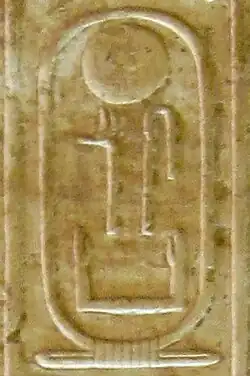
اوسرکارع دومین پادشاه دودمان ششم مصر بود. او را اغلب به عنوان کسی که با فرعون پیش از خود مخالفت کرد، میشناسند. این احتمال هست که او با نیرنگ پس از تتی به تخت نشسته باشد. با این حال بعضی مصرشناسان نیز بر این باورند که او پسر تتی و شهبانو خوییت بوده است. معنای نام او «روح رع نیرومند است»، میباشد.
یادداشتها
- ↑ Proposed dates for Userkare's reign: 2408–2404 BC,
2358–2354 BC,
2337–2335 BC,
2323–2321 BC,
2312–2310 BC,
2306–2302 BC,
2291–2289 BC,
2281–2277 BC,
2279–2276 BC,
2270–2265 BC.
منابع
- Nicolas Grimal (۱۹۹۲)، A History of Ancient Egypt، Blackwell Books، ص. ۸۱، شابک ۰۶۳۱۱۹۳۹۶۰
- Verner, Miroslav (۲۰۰۱)، The Pyramids - Their Archaeology and History، Atlantic Books، شابک ۱۹۰۳۸۰۹۴۵۲
کتابشناسی
- Allen, James; Allen, Susan; Anderson, Julie; Arnold, Arnold; Arnold, Dorothea; Cherpion, Nadine; David, Élisabeth; Grimal, Nicolas; Grzymski, Krzysztof; Hawass, Zahi; Hill, Marsha; Jánosi, Peter; Labée-Toutée, Sophie; Labrousse, Audran; Lauer, Jean-Phillippe; Leclant, Jean; Der Manuelian, Peter; Millet, N. B.; Oppenheim, Adela; Craig Patch, Diana; Pischikova, Elena; Rigault, Patricia; Roehrig, Catharine H.; Wildung, Dietrich; Ziegler, Christiane (1999). Egyptian Art in the Age of the Pyramids. New York: The Metropolitan Museum of Art. ISBN 978-0-81-096543-0. OCLC 41431623.
- Altenmüller, Hartwig (2001). "Old Kingdom: Sixth Dynasty". In Redford, Donald B. (ed.). The Oxford Encyclopedia of Ancient Egypt, Volume 2. Oxford University Press. pp. 601–605. ISBN 978-0-19-510234-5.
- Arnold, Dorothea (July 19, 1999). "Old Kingdom Chronology and List of Kings". Metropolitan Museum of Art. Retrieved March 31, 2015.
- Baker, Darrell (2008). The Encyclopedia of the Pharaohs: Volume I - Predynastic to the Twentieth Dynasty 3300–1069 BC. Stacey International. ISBN 978-1-905299-37-9.
- Baud, Michel; Dobrev, Vassil (1995). "De nouvelles annales de l'Ancien Empire Egyptien. Une "Pierre de Palerme" pour la VIe dynastie" (PDF). Bulletin de l'Institut Français d'Archéologie Orientale (به فرانسوی). 95: 23–92. Archived from the original (PDF) on 2015-04-02.
- Benderitter, Thierry; Hirst, Jon J. "Merefnebef". Osirisnet 2008-2023. Archived from the original on 2023-04-18.
- Brand, Peter J. (2002). "Review: Abusir and Saqqara in the Year 2000 by Miroslav Bárta, Jaromír Krejčí". Journal of the American Research Center in Egypt. 39: 254–256. doi:10.2307/40001162. JSTOR 40001162. S2CID 191611152.
- Callender, Vivianne Gae (1991). "A contribution to discussion on the title of sƷt nṯr". Studien zur Altägyptischen Kultur. 18: 89–111. JSTOR 44325756.
- Callender, Vivianne Gae (2002). "Princess Inti of the Ancient Egyptian Sixth Dynasty". Journal of Near Eastern Studies. 61 (4): 267–274. doi:10.1086/469041. JSTOR 3128942. S2CID 162296379.
- "Cylinder Seal Bearing the Name Userkere". Brooklyn Museum. Retrieved 19 April 2023.
- Dobrev, Vassil (1993). "Considérations sur les titulatures des rois de la IVe dynastie égyptienne". Bulletin de l'Institut Français d'Archéologie Orientale (به فرانسوی). Cairo: Institut Français d'Archéologie Orientale: 179–204.
- Dobrev, Vassil (2006). "Old Kingdom Tombs at Tabbet al-Guesh (South Saqqara)". In Bárta, Miroslav; Coppens, Filip; Krejci, Jaromir (eds.). Abusir and Saqqara in the Year 2005. Prague: Czech Institute of Egyptology, Faculty of Arts, Charles University in Prague. pp. 229–235. ISBN 978-8-07-308116-4.
- Dodson, Aidan; Hilton, Dyan (2004). The Complete Royal Families of Ancient Egypt. London: Thames & Hudson Ltd. ISBN 978-0-50-005128-3.
- Goedicke, Hans (1986). "Userkare". In Helck, Wolfgang; Otto, Eberhard; Westendorf, Wolfhart (eds.). Lexikon der Ägyptologie: Band VI. Stele-Zypresse (به آلمانی). Wiesbaden: Otto Harrassowitz. ISBN 978-3-44-702663-5.
- Grimal, Nicolas (1992). A History of Ancient Egypt. Translated by Ian Shaw. Oxford: Blackwell publishing. ISBN 978-0-63-119396-8.
- Hayes, William (1970). "The Old Kingdom in Egypt". In Edwards, I. E. S.; Gadd, C. J.; Hammond, N. G. L. (eds.). The Cambridge Ancient History, Vol. 1, Part 1. Cambridge: Cambridge University Press. pp. 178–179. ISBN 978-0-52-107051-5.
- Hayes, William (1978). The Scepter of Egypt: A Background for the Study of the Egyptian Antiquities in The Metropolitan Museum of Art. Vol. 1, From the Earliest Times to the End of the Middle Kingdom. New York: Metropolitan Museum of Art. OCLC 7427345.
- Hornung, Erik; Krauss, Rolf; Warburton, David, eds. (2012). Ancient Egyptian Chronology. Handbook of Oriental Studies. Leiden, Boston: Brill. ISBN 978-90-04-11385-5. ISSN 0169-9423.
- Kanawati, Naguib (2003). Conspiracies in the Egyptian Palace: Unis to Pepy I. London; New York: Routledge. ISBN 978-0-20-316673-4.
- Kaplony, Peter (1965). "Bemerkungen zu einigen Steingefäßen mit archaïschen Königsnamen". Mitteilungen des Deutschen Archäologischen Instituts, Abteilung Kairo (به آلمانی). 20: 1–46.
- Kaplony, Peter (1981). Die Rollsiegel des Alten Reiches. Band II; Text A: Katalog der Rollsiegel. Text B: Tafeln. Monumenta Aegyptiaca, 3B (به آلمانی). Bruxelles: Fondation Egyptologique Reine Élisabeth. OCLC 58642039.
- Krauss, Rolf (2021). "Late Old Kingdom Chronology – Another Model". Ägypten und Levante / Egypt and the Levant. 31: 293–300. doi:10.1553/AEundL31s293. JSTOR 27153344. S2CID 245590988.
- Magli, Giulio (2010). "Archaeoastronomy and the archaeo=topography as tools in the search for a missing Egyptian pyramid". PalArch's Journal of Archaeology of Egypt/Egyptology. 7 (5): 1–9.
- Malek, Jaromir (2000). "The Old Kingdom (c.2160-2055 BC)". In Shaw, Ian (ed.). The Oxford History of Ancient Egypt. Oxford University Press. ISBN 978-0-19-815034-3.
- Myśliwiec, Karol (1999). "Meref-nebef: Berater des Pharaos". Spektrum der Wissenschaft (به آلمانی). Heidelberg: Spektrum der Wissenschaft Verlagsgesellschaft mbH. 12: 54–60.
- Myśliwiec, Karol (2007). "The Scheme 2 x 4 in the Decoration of Old Kingdom Tombs". In Hawass, Zahi; Richards, Janet (eds.). The Archaeology and Art of Ancient Egypt. Essays in Honor of David B. O'Connor. Volume II (PDF). Annales du Services des Antiquités de l'Égypte. Vol. cahier n°36. Cairo: Conseil Suprême des Antiquités de l'Égypte. ISBN 978-9-77-437241-4.
- Petrie, William Matthew Flinders (1907). A History of Egypt. Volume 1: from the earliest times to the XVIth dynasty (6th ed.). London: Methuen & co. OCLC 1524193.
- Roth, Ann Macy (1991). Egyptian Phyles in the Old Kingdom: The Evolution of a System of Social Organization. Studies in Ancient Oriental Civilization 48. Chicago: The Oriental Institute. ISBN 978-0-91-898668-9.
- Stadelmann, Rainer (1994). "König Teti und der Beginn der 6. Dynastie". In Berger, Catherine; Clerc, Gisèle; Grimal, Nicolas (eds.). Hommages à Jean Leclant. Volume 1. Études pharaoniques (به آلمانی). Cairo: Institut Français d'Archéologie Orientale. pp. 327–336. ISBN 978-2-72-470137-1.
- Stevenson Smith, William (1971). "The Old Kingdom in Egypt". In Edwards, I. E. S.; Gadd, C. J.; Hammond, N. G. L. (eds.). The Cambridge Ancient History, Vol. 1, Part 2: Early History of the Middle East. Cambridge: Cambridge University Press. pp. 145–207. ISBN 978-0-52-107791-0.
- Strudwick, Nigel (2005). Texts from the Pyramid Age (annotated ed.). Society of Biblical Literature. ISBN 978-1-58983-138-4.
- von Beckerath, Jürgen (1999). Handbuch der ägyptischen Königsnamen (به آلمانی). Münchner ägyptologische Studien, Heft 49, Mainz : Philip von Zabern. ISBN 978-3-8053-2591-2.
- Waddell, William Gillan (1971). Manetho. Loeb classical library, 350. Cambridge, Massachusetts; London: Harvard University Press; W. Heinemann. OCLC 6246102.