شپسسکاف
| شِپسِسکاف(شپسس کالاف) | |
|---|---|
| شِپسِسکاف، سِبرکِریس، سِوِرکِریس | |
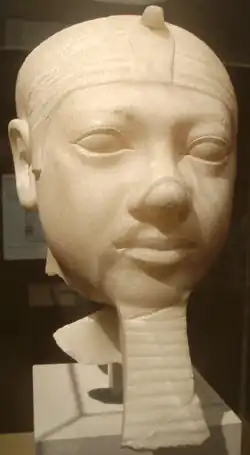 | |
| فرعون | |
| فرمانروایی | مدت سلطنت نامعلوم, احتمالاً چهار سال اما شاید هم تا هفت سال[۱] در اواخر قرن ۲۶ تا اواسط قرن ۲۵ پیش از میلاد[note ۱] (دودمان چهارم مصر) |
| پیشین | منکورع |
| جانشین | اوسرکاف (به احتمال زیاد) یا جِدِفپتاح (ثامفثیس) |
| همسر(ان) | نامعلوم؛ خنتکاوس یکم یا بونفر |
| فرزندان | احتمالا بونفر (♀)، حدسی اوسرکاف (♂) |
| پدر | منکورع (غیر قطعی) |
| مادر | نامعلوم؛ خعمررنبتی دوم، رخترع، خنتکاوس یا نفرتحتپس |
| آرامگاه | مصطبة الفرعون |
| آثار بر جای مانده | تکمیل مجموعه هرم منکورع، مصطبة الفرعون |


شِپسِسکاف فرعونی از دودمان چهارم تاریخ مصر در دوره پادشاهی کهن بود. او فرزند و جانشین منکورع بود. معنای نام او «روان او بلند و والا است» میباشد.[۳۰]
دوران
شِپسِسکاف به احتمال زیاد میبایست واپسین پادشاه دودمان چهارم بوده باشد؛ این در صورتی است که پس از او فرعون ناشناسی به نام جِدِفپتاح به تخت نشسته باشد. نام جِدِفپتاح در بعضی منابع نوشتاری تاریخی مصر از جمله فهرست تورین دیده میشود. نام جِدِفپتاح اما در هیچ منبع معاصر آن زمان همچون تندیسهای شاهانه و گورهای واقع در جیزه و سقاره دیده نمیشود.[۳۱]
طبق نوشتار فهرست تورین، شِپسِسکاف ۴ سال فرمانروایی کرد و جانشین او در دودمان چهارم - اشاره احتمالی به جِدِفپتاح - تنها دو سال بر تخت بود. مانثون اما طول دوران فرمانروایی او را ۷ سال ذکر میکند که ممکن است نتیجه جمع ۴ سال فهرست تورین و ۲ سال جانشین او به همراه بخشی از ماههای یک سال بوده باشد.
یادداشتها
- ↑ Proposed dates for the reign of Shepseskaf: 2523–2519 BC,[۲][۳][۴][۵] ending 2510 BC,[۶] 2511–2506 BC,[۷][۸] 2504–2500BC,[۹] 2503–2498 BC,[۱۰][۱۱][۱۲] ending 2494 BC,[۱۳][۱۴] 2486–2479 BC,[۱۵] 2472–2467 BC,[۱۶][۱۷][۱۸] ending 2465 BC,[۱۹] 2462–2457 BC,[۲۰] 2461–2456 BC,[۷] 2442–2436 BC,[۲۱] 2441–2438 BC,[۲۲] 2441–2436 BC,[۲۳] ending 2435 BC,[۲۴] 2396–2392 BC.[۲۵] Radiocarbon studies have yielded the following intervals for Shepseskaf's date of accession to the throne: 2538–2498 BC with 68% probability, 2556–2476 BC with 95% probability.[۲۶] These studies are based archaeological samples to measure fluctuations in radiocarbon activity, specific information on radiocarbon activity in the region of the Nile Valley (anchored by dendrochronology to absolute dates), direct linkages between the dated samples and historical chronology and relative dating information. Samples dated to specific reigns were collected from museum collections and excavation material while certain types of material (notably charcoal and mummified remains) were avoided owing to their susceptibility to contamination.[۲۷]
- 1 2 The word "his" here may refer to the god Ra rather than to the pharaoh.[۲۸]
منابع
- 1 2 Schneider 2002, p. 248.
- ↑ Stadelmann 2001, p. 597.
- ↑ Chauvet 2001, p. 176.
- ↑ El-Shahawy & Atiya 2005, p. 33.
- ↑ Verner 2001c, p. 588.
- ↑ Grimal 1992, p. 390.
- 1 2 von Beckerath 1997, p. 188.
- ↑ Strudwick 2005, p. xxx.
- ↑ Clayton 1994, p. 56.
- ↑ Málek 2000, p. 91.
- ↑ Rice 1999, p. 190.
- ↑ Sowada 2009, p. 3.
- ↑ Bard 1999, pp. xliv–xlv.
- ↑ Baker 2008, pp. 425–426.
- ↑ von Beckerath 1999, p. 283.
- ↑ Lehner 2008, p. 8.
- ↑ Allen et al. 1999, p. xx.
- ↑ Kozloff 1982, p. 214.
- ↑ Encyclopædia Britannica 2022.
- ↑ Vernus & Yoyotte 1996, p. 219.
- ↑ Bárta 2016, p. 51.
- ↑ Strudwick 1985, p. 3.
- ↑ Hornung 2012, p. 491.
- ↑ Bárta 2017, p. 5.
- ↑ Dodson & Hilton 2004, p. 288.
- ↑ Ramsey et al. 2010, p. 1556.
- ↑ Ramsey et al. 2010, p. 1554.
- ↑ Stadelmann 2000, pp. 535–536.
- ↑ Gardiner 1959, p. 16, table II.
- ↑ Peter A. Clayton (۲۰۰۴)، Chronicle of the Pharaohs: The Reign-By-Reign Record of the Rulers and Dynasties of Ancient Egypt، Thames & Hudson، ص. ۵۶، شابک ۰۹۰۰۴۱۶۸۲۳
- ↑ P.F. O'Mara (۱۹۹۷)، Manetho and the Turin Canon: A Comparison of Regnal Years، Thames & Hudson، ص. ۵۶، شابک ۰۹۰۰۴۱۶۸۲۳
کتابشناسی
- Allen, James; Allen, Susan; Anderson, Julie; Arnold, Arnold; Arnold, Dorothea; Cherpion, Nadine; David, Élisabeth; Grimal, Nicolas; Grzymski, Krzysztof; Hawass, Zahi; Hill, Marsha; Jánosi, Peter; Labée-Toutée, Sophie; Labrousse, Audran; Lauer, Jean-Phillippe; Leclant, Jean; Der Manuelian, Peter; Millet, N. B.; Oppenheim, Adela; Craig Patch, Diana; Pischikova, Elena; Rigault, Patricia; Roehrig, Catharine H.; Wildung, Dietrich; Ziegler, Christiane (1999). Egyptian Art in the Age of the Pyramids. New York: The Metropolitan Museum of Art. OCLC 41431623.
- Baker, Darrell (2008). The Encyclopedia of the Pharaohs: Volume I – Predynastic to the Twentieth Dynasty 3300–1069 BC. London: Stacey International. ISBN 978-1-905299-37-9.
- Bard, Kathryn A. (1999). "Chronology of Ancient Egypt". In Bard, Kathryn A.; Blake Shubert, Steven (eds.). Encyclopedia of the Archeology of Ancient Egypt. New York: Routledge. pp. xliii–lii. ISBN 978-0-203-98283-9.
- Bárta, Miroslav (2016). "'Abusir Paradigm' and the Beginning of the Fifth Dynasty". In Hein, Irmgard; Billing, Nils; Meyer-Dietrich, Erika (eds.). The Pyramids between life and death : proceedings of the workshop held at Uppsala University, May 31st – June 1st, 2012. Acta Universitatis Upsaliensis. Boreas. Vol. 36. Uppsala: Uppsala Universitet. pp. 51–74. ISBN 978-9-15-549169-7.
- Bárta, Miroslav (2015). "Tomb of the chief physician Shepseskafankh". Prague Egyptological Studies. Czech Institute of Egyptology. XV: 15–27. ISSN 1801-3899.
- Bárta, Miroslav (2017). "Radjedef to the Eighth Dynasty". UCLA Encyclopedia of Egyptology. San Diego: The University of California. 1 (1).
- Bérard, Jean (1937). "Remarques sur une erreur historique d'Hérodote (II, 124-136)". Revue des Études Grecques (به فرانسوی). 50 (236/237): 289–292. doi:10.3406/reg.1937.2823. JSTOR 44271513.
- Bogdanov, Ivan (2020). "The Old Kingdom evidence on the toponym ḫntj-š "Lebanon"". Ägypten und Levante / Egypt and the Levant. Austrian Academy of Sciences Press. 29: 125–148. doi:10.1553/AEundL29s125. JSTOR 26926564. S2CID 243567455.
- Breasted, James Henry (1906). Ancient records of Egypt historical documents from earliest times to the Persian conquest, collected edited and translated with commentary, vol. I The First to the Seventeenth Dynasties. Chicago: The University of Chicago Press. OCLC 491147601.
- Burkard, Günter; Thissen, Heinz Josef; Quack, Joachim Friedrich (2003). Einführung in die altägyptische Literaturgeschichte. Band 1: Altes und Mittleres Reich. Einführungen und Quellentexte zur Ägyptologie. Vol. 1, 3, 6. Münster: LIT. ISBN 978-3-82-580987-4.
- Callender, Vivienne Gae (1994). "Part III. A prosopographical register of the wives of the Egyptian Kings (Dynasties I–XVII)". The wives of the Egyptian kings: dynasties I–XVII. Sydney, Australia: Macquarie University. School of History, Philosophy, and Politics. OCLC 862671624. Archived from the original on 27 April 2022. Retrieved 29 May 2022.
- Chauvet, Violaine (2001). "Saqqara". In Redford, Donald B. (ed.). The Oxford Encyclopedia of Ancient Egypt, Volume 3. Oxford: Oxford University Press. pp. 176–179. ISBN 978-0-19-510234-5.
- Clayton, Peter (1994). Chronicle of the Pharaohs. New York: Thames & Hudson. ISBN 978-0-500-05074-3.
- Daressy, Georges (1912). "La Pierre de Palerme et la chronologie de l'Ancien Empire". Bulletin de l'Institut Français d'Archéologie Orientale (به فرانسوی). Cairo. 12: 161–214. doi:10.3406/bifao.1916.1736. ISSN 0255-0962. Retrieved 11 August 2018.
- David, Ann Rosalie; David, Antony E (2001). A Biographical Dictionary of Ancient Egypt. London: Seaby. ISBN 978-1-85-264032-3.
- de Rougé, Emmanuel (1865). Recherches sur les monuments qu'on peut attribuer aux six premières dynasties de Manéthon (به فرانسوی). Paris: Institut de France, Académie des inscriptions et belles-lettres. OCLC 1026731127.
- Dodson, Aidan; Hilton, Dyan (2004). The Complete Royal Families of Ancient Egypt. London: Thames & Hudson. ISBN 978-0-500-05128-3.
- Dorman, Peter (2002). "The biographical inscription of Ptahshepses from Saqqara: A newly identified fragment". Journal of Egyptian Archaeology. 88: 95–110. doi:10.1177/030751330208800107. JSTOR 3822338. S2CID 193353936.
- Dunham, Dows (1935). "Four New Kingdom Monuments in the Museum of Fine Arts, Boston". The Journal of Egyptian Archaeology. Sage Publications, Inc. 21 (2): 147–151. doi:10.2307/3854707. JSTOR 3854707.
- El Awady, Tarek (2006). "The royal family of Sahure. New evidence" (PDF). In Bárta, Miroslav; Krejčí, Jaromír (eds.). Abusir and Saqqara in the Year 2005. Prague: Academy of Sciences of the Czech Republic, Oriental Institute. pp. 31–45. ISBN 978-80-7308-116-4. Archived from the original (PDF) on 1 February 2011.
- El-Shahawy, Abeer; Atiya, Farid S. (2005). The Egyptian Museum in Cairo. A Walk Through The Alleys of Ancient Egypt. Cairo: Farid Atiya Press. ISBN 978-9-77-171983-0.
- "False door of Nikauhor's tomb". The Giza Archive. Museum of Fine Arts Boston. 1936. Retrieved 3 June 2022.
- Gardiner, Alan (1959). The Royal Canon of Turin. Oxford: Griffith Institute. OCLC 21484338.
- Gourdon, Yannis (2007). Recherches sur l'anthroponymie dans l'Égypte du IIIe millénaire avant J.-C.: signification et portée sociale du nom égyptien avant le Moyen Empire (PhD). Lyon: Université Lumière Lyon 2.
- Goedicke, Hans (2000). "Abusir–Saqqara–Giza". In Bárta, Miroslav; Krejčí, Jaromír (eds.). Abusir and Saqqara in the year 2000. Archiv Orientální, Supplementa. Vol. 9. Prague: Academy of Sciences of the Czech Republic, Oriental Institute. pp. 397–412. ISBN 978-8-08-542539-0.
- Grimal, Nicolas (1992). A History of Ancient Egypt. Translated by Ian Shaw. Oxford: Blackwell Publishing. ISBN 978-0-631-19396-8.
- Hassan, Selim (1936). Excavations at Gîza II, 1930-1931. Cairo: Faculty of Arts of the Egyptian University & Government Press. pp. 75–86, figs. 81–91, pls. 23–26. OCLC 1242410271.
- Hassan, Selim; Habashi, Banoub (1941). Excavations at Gîza III, 1931-1932. Cairo: Government Press, Bulaq. OCLC 660023462.
- Hassan, Selim (1943). Excavations at Giza. Volume IV. Cairo: Government Press. OCLC 1181487436.
- Hayes, William (1978). The Scepter of Egypt: A Background for the Study of the Egyptian Antiquities in The Metropolitan Museum of Art. Vol. 1, From the Earliest Times to the End of the Middle Kingdom. New York: Metropolitan Museum of Art. OCLC 7427345.
- "Head of King Menkaura (Mycerinus)". Museum of Fine Arts Boston. 1908. Retrieved 7 June 2022.
- Herodotus (1963). Godley, Alfred Denis (ed.). The Histories. Herodotus, With an English Translation by A. D. Godley. Cambridge, Mass.: Harvard University Press. OCLC 936469061.
- Hornung, Erik; Krauss, Rolf; Warburton, David, eds. (2012). Ancient Egyptian Chronology. Handbook of Oriental Studies. Leiden, Boston: Brill. ISBN 978-90-04-11385-5. ISSN 0169-9423.
- How, Walter Wybergh; Wells, Joseph (1991). A commentary on Herodotus. Oxford, New York: Oxford University Press. ISBN 978-0-19-814384-0. OCLC 489656669.
- Hsu, Shih-Wei (2012). "The development of Ancient Egyptian royal inscriptions". The Journal of Egyptian Archaeology. Sage Publications, Inc. 98: 269–283. doi:10.1177/030751331209800115. JSTOR 24645014. S2CID 190032178.
- Janák, Jiří; Vymazalová, Hana; Coppens, Filip (2011). "The Fifth Dynasty "sun temples" in a broader context". In Bárta, Miroslav; Coppens, Filip; Krejčí, Jaromír (eds.). Abusir and Saqqara in the Year 2010. Prague: Charles University in Prague, Faculty of Arts. pp. 430–442. ISBN 978-8-07-308385-4.
- Jánosi, Peter (2005). Giza in der 4. Dynastie. Die Baugeschichte und Belegung einer Nekropole des Alten Reiches. Band I: Die Mastabas der Kernfriedhöfe und die Felsgräber (به آلمانی). Wien: Verlag der Österreichischen Akademie der Wissenschaften. ISBN 3-7001-3244-1.
- Jéquier, Gustave (1925). "Le Mastabat-el-Faraoun et le culte funéraire de Shepseskaf". Comptes rendus des séances de l'Académie des Inscriptions et Belles-Lettres Année 1925 (به فرانسوی). 69 (4): 251–261. doi:10.3406/crai.1925.75168.
- Katary, Sally (2001). "Taxation". In Redford, Donald B. (ed.). The Oxford Encyclopedia of Ancient Egypt, Volume 3. Oxford: Oxford University Press. pp. 351–356. ISBN 978-0-19-510234-5.
- "Kaunisut (G 8960)". Digital Giza. 2022 Giza Project at Harvard University. 2022. Retrieved 6 June 2022.
- Kozloff, Arielle P. (1982). "Weserkaf, Boy King of Dynasty V". The Bulletin of the Cleveland Museum of Art. 69 (7): 211–223. JSTOR 25159780.
- Lehner, Mark (2002). "The Pyramid Age Settlement of the Southern Mount at Giza". Journal of the American Research Center in Egypt. American Research Center in Egypt. 39: 27–74. doi:10.2307/40001149. JSTOR 40001149.
- Lehner, Mark (2008). The Complete Pyramids. London: Thames & Hudson Ltd. ISBN 978-0-500-05084-2.
- Lepsius, Carl Richard (1897) [first publication 1841–1859]. Denkmäler aus Ägypten und Äthiopien. Vol. I, Unteraegypten und Memphis. Leipzig: J. C. Hinrichs'sche Buchhandlung. OCLC 458103866. Retrieved 8 May 2016.
- Lichtheim, Miriam (2006). Ancient Egyptian literature: a book of readings. The Old and Middle Kingdoms. Vol. I. Berkeley: University of California Press. ISBN 978-0-52-024842-7.
- Málek, Jaromir (1992). "A Meeting of the Old and New. Saqqâra during the New Kingdom". In Lloyd, Alan B. (ed.). Studies in Pharaonic Religion and Society. In Honour of J. Gwyn Griffiths. The Egypt Exploration Society. Occasional Publications. Vol. 8. London: Egypt Exploration Society. pp. 57–76. ISBN 0-85698-120-6.
- Málek, Jaromir (2000). "The Old Kingdom (c. 2160–2055 BC)". In Shaw, Ian (ed.). The Oxford History of Ancient Egypt. Oxford University Press. pp. 83–107. ISBN 978-0-19-815034-3.
- Maragioglio, Vito; Rinaldi, Celeste (1967). L'architettura delle piramidi Menfite. Parte VI, La grande fossa di Zauiet el-Aryan, la Piramide di Micerino, il Mastabat Faraun, la Tomba di Khentkaus (به ایتالیایی). Rapallo: Officine Grafiche Canessa. OCLC 1044725030.
- Morales, Antonio J. (2006). "Traces of official and popular veneration to Nyuserra Iny at Abusir. Late Fifth Dynasty to the Middle Kingdom". In Bárta, Miroslav; Coppens, Filip; Krejčí, Jaromír (eds.). Abusir and Saqqara in the Year 2005, Proceedings of the Conference held in Prague (June 27 – July 5, 2005). Prague: Academy of Sciences of the Czech Republic, Oriental Institute. pp. 311–341. ISBN 978-80-7308-116-4.
- Nuzzolo, Massimiliano (2007). "The Sun Temples of the Vth Dynasty: A Reassessment". Studien zur Altägyptischen Kultur. Helmut Buske Verlag GmbH. 36: 217–247. JSTOR 25157803.
- Nuzzolo, Massimiliano; Krejčí, Jaromír (2017). "Heliopolis and the solar cult in the third millenium BC" (PDF). Ägypten und Levante / Egypt and the Levant. 27: 357–380. doi:10.1553/AEundL27s357. JSTOR 26524908.
- O'Mara, Patrick F. (1996). "Was There an Old Kingdom Historiography? Is It Datable?". Orientalia. Nova Series. Gregorian Biblical Press. 65 (3): 197–208. JSTOR 43078130.
- O'Mara, Patrick F. (1997). "Manetho and the Turin Canon: A Comparison of Regnal Years". Göttinger Miszellen. 158: 49–61. ISSN 0344-385X.
- Quirke, Stephen (2001). The Cult of Ra. Sun-Worship in Ancient Egypt. New York: Thames and Hudson. ISBN 978-0500051078.
- Ramsey, Christopher Bronk; Dee, Michael W.; Rowland, Joanne M.; Higham, Thomas F. G.; Harris, Stephen A.; Brock, Fiona; Quiles, Anita; Wild, Eva M.; Marcus, Ezra S.; Shortland, Andrew J. (2010). "Radiocarbon-Based Chronology for Dynastic Egypt". Science. New Series. American Association for the Advancement of Science. 328 (5985): 1554–1557. Bibcode:2010Sci...328.1554R. doi:10.1126/science.1189395. JSTOR 40656429. PMID 20558717. S2CID 206526496.
- Redford, Donald B. (2001). "Manetho". In Redford, Donald B. (ed.). The Oxford Encyclopedia of Ancient Egypt, Volume 2. Oxford: Oxford University Press. pp. 336–337. ISBN 978-0-19-510234-5.
- Reisner, Georges A. (1931). Mycerinus: The Temples of the Third Pyramid at Giza. Cambridge, MA.: Harvard University Press. OCLC 248947316.
- Reisner, Georges A. (1939). "A Family of Royal Estate Stewards of Dynasty V". Bulletin of the Museum of Fine Arts. Boston: Museum of Fine Arts, Boston. 37 (220): 29–35. JSTOR 4170711.
- Rice, Michael (1999). Who is who in Ancient Egypt. London; New York: Routledge. ISBN 978-0-203-44328-6.
- Ricke, Herbert (1950). Bemerkungen zur Ägyptischen Baukunst des Alten Reichs II. Beiträge zur Ägyptischen Bauforschung und Altertumskunde. Vol. 5. Cairo: Institut für Ägytpsiche Bauforschung und Altertumskunde. OCLC 1128384201.
- Ryholt, Kim (1997). The Political Situation in Egypt during the Second Intermediate Period, c. 1800–1550 B.C. CNI publications, 20. Copenhagen: Carsten Niebuhr Institute of Near Eastern Studies, University of Copenhagen : Museum Tusculanum Press. ISBN 978-87-7289-421-8.
- Etheredge, Laura (ed.). "Saqqarah". Encyclopædia Britannica. Retrieved 5 June 2022.
- Schneider, Thomas (2002). Lexikon der Pharaonen (به آلمانی). Düsseldorf: Patmos Albatros Verlag. ISBN 978-3-49-196053-4.
- Sethe, Kurt Heinrich (1903). Urkunden des Alten Reichs (به آلمانی). wikipedia entry: Urkunden des Alten Reichs. Leipzig: J.C. Hinrichs. OCLC 846318602.
- "Shepseskafankh (G 8492)". Digital Giza. 2022 Giza Project at Harvard University. 2022. Retrieved 30 May 2022.
- "Shepseskafankh (G 8983)". Digital Giza. 2022 Giza Project at Harvard University. 2022. Retrieved 30 May 2022.
- "Shepseskafankh (G 1008)". Digital Giza. 2022 Giza Project at Harvard University. 2022. Retrieved 30 May 2022.
- "Shepseskafankh (G 6040)". Digital Giza. 2022 Giza Project at Harvard University. 2022. Retrieved 3 June 2022.
- Smith, William Stevenson (1971). "The Old Kingdom of Egypt and the Beginning of the First Intermediate Period". In Edwards, I. E. S.; Gadd, C. J.; Hammond, N. G. L. (eds.). The Cambridge Ancient History, Volume 1, Part 2. Early History of the Middle East (3rd ed.). London, New york: Cambridge University Press. pp. 145–207. ISBN 978-0521077910. OCLC 33234410.
- Sowada, Karin N. (2009). Egypt in the Eastern Mediterranean During the Old Kingdom: An Archaeological Perspective. Orbis Biblicus et Orientalis. Vol. 237. Fribourg, Switzerland: Academic Press Fribourg, Vandenhoeck & Ruprecht Göttingen. ISBN 978-3-7278-1649-9.
- Spalinger, Anthony (1994). "Dated Texts of the Old Kingdom". Studien zur Altägyptischen Kultur. 21: 275–319. JSTOR 25152700.
- Stadelmann, Reiner (2000). "Userkaf in Saqqara und Abusir. Untersuchungen zur Thronfolge in der 4. und frühen 5. Dynastie". In Bárta, Miroslav; Krejčí, Jaromír (eds.). Abusir and Saqqara in the Year 2000. Archiv Orientální, Supplementa (به آلمانی). Vol. IX. Prague: Academy of Sciences of the Czech Republic, Oriental Institute. pp. 529–542. ISBN 978-8-08-542539-0. OCLC 48015047.
- Stadelmann, Rainer (2001). "Old Kingdom: Fourth Dynasty". In Redford, Donald B. (ed.). The Oxford Encyclopedia of Ancient Egypt, Volume 2. Oxford: Oxford University Press. pp. 593–597. ISBN 978-0-19-510234-5.
- "Standfigur des Ba-ba-ef". Kunsthistorisches Museum Wien. 1914. Retrieved 7 June 2022.
- Strudwick, Nigel (1985). The Administration of Egypt in the Old Kingdom: The Highest Titles and Their Holders (PDF). Studies in Egyptology. London; Boston: Kegan Paul International. ISBN 978-0-7103-0107-9.
- Strudwick, Nigel C. (2005). Texts from the Pyramid Age. Writings from the Ancient World (book 16). Atlanta: Society of Biblical Literature. ISBN 978-1-58983-680-8.
- Troy, Lana (1986). Patterns of queenship in ancient egyptian myth and history. Boreas. Vol. 14. Uppsala: Upsaliensis Academiae. ISBN 9789155419196. OCLC 963431998.
- Tyldesley, Joyce (2005). À la découverte des pyramides d'Égypte. Champollion (به فرانسوی). Translated by Nathalie Baum. Monaco: Éditions du Rocher. ISBN 978-2-268-05326-4.
- Vercoutter, Jean (1992). L'Egypte et la vallée du Nil. Tome 1, Des origines à la fin de l'Ancien Empire 12000-2000 av. J.-C. Nouvelle Clio (به فرانسوی). Vol. 50. Paris: Presses Universitaires de France. ISBN 9782130441571. OCLC 611721854.
- Verner, Miroslav; Zemina, Milan (1994). Forgotten pharaohs, lost pyramids: Abusir (PDF). Praha: Academia Škodaexport. ISBN 978-80-200-0022-4. Archived from the original (PDF) on 1 February 2011.
- Verner, Miroslav (2001a). "Archaeological Remarks on the 4th and 5th Dynasty Chronology" (PDF). Archiv Orientální. 69 (3): 363–418. ISSN 0044-8699.
- Verner, Miroslav (2001b). "Pyramid". In Redford, Donald B. (ed.). The Oxford Encyclopedia of Ancient Egypt, Volume 3. Oxford: Oxford University Press. pp. 87–95. ISBN 978-0-19-510234-5.
- Verner, Miroslav (2001c). "Old Kingdom: An Overview". In Redford, Donald B. (ed.). The Oxford Encyclopedia of Ancient Egypt, Volume 2. Oxford: Oxford University Press. pp. 585–591. ISBN 978-0-19-510234-5.
- Verner, Miroslav (2007). "Sahure's Causeway. New Archaeological Discoveries in the Abusir Pyramid Field". Archaeogate Egittologia. ISSN 1973-2953. Archived from the original on 16 July 2011. Retrieved 11 August 2018.
- Verner, Miroslav (2010). "Some considerations concerning the Old Kingdom royal palace (aH)". Anthropologie. XLVIII (2): 91–96. ISSN 0323-1119.
- Vernus, Pascal; Yoyotte, Jean (1996). Dictionnaire des Pharaons (به فرانسوی). Paris: Noêsis. p. 220. ISBN 2-911606-08-6.
- von Beckerath, Jürgen (1984). "Schepseskaf". In Helck, Wolfgang; Eberhard, Otto (eds.). Lexikon der Ägyptologie (به آلمانی). Vol. V. Pyramidenbau–Steingefäße. Wiesbaden: Harrassowitz. p. 584. ISBN 3-447-02489-5.
- von Beckerath, Jürgen (1997). Chronologie des pharaonischen Ägypten : die Zeitbestimmung der ägyptischen Geschichte von der Vorzeit bis 332 v. Chr. Münchner ägyptologische Studien (به آلمانی). Vol. 46. Mainz am Rhein: Philipp von Zabern. ISBN 978-3-8053-2310-9.
- von Beckerath, Jürgen (1999). Handbuch der ägyptischen Königsnamen. Münchner ägyptologische Studien (به آلمانی). Mainz: Philip von Zabern. ISBN 978-3-8053-2591-2.
- Waddell, William Gillan (1971). Manetho. Loeb classical library, 350. Cambridge, Massachusetts; London: Harvard University Press; W. Heinemann. OCLC 6246102.
- Wildung, Dietrich (1969). Die Rolle ägyptischer Könige im Bewußtsein ihrer Nachwelt. Teil I. Posthume Quellen über die Könige der ersten vier Dynastien. Münchener Ägyptologische Studien (به آلمانی). Vol. 17. München, Berlin: Deutscher Kunstverlag. OCLC 1151084273.
- Wildung, Dietrich (1977). Helck, Wolfgang; Eberhard, Otto (eds.). Lexikon der Ägyptologie (به آلمانی). Vol. II. Erntefest–Hordjedef. Wiesbaden: Harrassowitz. p. 1257. ISBN 3-447-01876-3.
پیوند به بیرون

اطلاعات بیشتر درباره شِپسِسکاف، به زبان انگلیسی