در علوم فیزیکی، تضمین کیفیت، مهندسی، اندازهگیری روشهایی برای بیانکنند و مقایسهٔ کمیت فیزیکی اجسام و پدیدههای دنیای واقعی هستند.
برای تعریف اجسام و رویدادها به صورت استاندارد نیاز به استفاده از یکاها هست و روند اندازهگیری اعدادی را در اختیار میگذارد که مرتبط با موارد مورد مطالعه هستند و به یکای اندازهگیری اشاره دارند.
ابزارهای اندازهگیری و روشهای آزمودن که روش استفاده از ابزارها را تعریف میکنند مقدار متوسط رابطهٔ بین عددها و یکاها را مشخص میکنند خطای ابزار و خطای عدم قطعیت در استفاده از ابزارهای اندازهگیری وجود دارد.
دانشمندان و مهندسین و بهطور کلی انسانها از ابزارهای اندازهگیری مختلفی برای شرح محیط اطراف خوداستفاده میکنند که شامل سادهترین موارد مانند خطکش تا پیچیدهترین آنها مانند میکروسکوپ الکترونی و شتابدهنده ذرهای میشود.
از ابزارهای مجازی برای توسعه ابزارهای اندازهگیری جدید استفاده میشود.
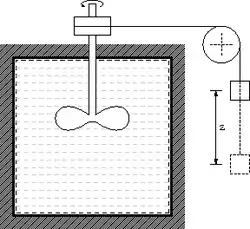
Changing energy carriers, linear momentum to angular momentum. No measurement primarily intended.
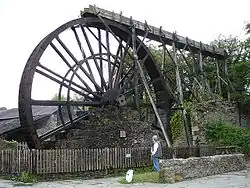
Example: In a plant that furnishes نیروگاه تلمبه ذخیرهای, کار (فیزیک) and electrical work is done by machines like electric پمپs and مولد الکتریکیs. The pumped water stores mechanical work. The amount of energy put into the system equals the amount of energy which comes out of the system, less that amount of energy used to overcome اصطکاک.
Such examples suggested the derivation of some unifying concepts: Instead of discerning (transferred) forms of work or stored work, there has been introduced one single کمیت فیزیکی called energy. Energy is assumed to have substance-like qualities; energy can be apportioned and transferred. Energy cannot be created from nothing, or to be annihilated to nothing, thus energy becomes a conserved quantity, when properly balanced.
Describing the transfer of energy two dictions, two ways of wording are used:
(energy carriers exchanging energy) Physical interactions occur by carriers (linear momentum, electric charge, entropy) exchanging energy. For example, a generator transfers energy from angular momentum to electric charge.[۱]
Often the energy value results from multiplying two related quantities: (a generalized) potential (relative velocity, voltage, temperature difference) times some substance-like quantity (linear momentum, electrical charge, entropy). — Thus energy has to be measured by first choosing a carrier/form. The measurement usually happens indirectly, by obtaining two values (potential and substance-like quantity) and by multiplying their values.
For the ranges of energy-values see: Orders of magnitude (energy)
Power (flux of energy)
A physical system that exchanges energy may be described by the amount of energy exchanged per time-زمان, also called power or شار of energy.
(see any measurement device for power below)
Action
Action describes energy summed up over the time a process lasts (time انتگرال over energy). Its بعد is the same as that of an تکانه زاویهای.
A phototube provides a voltage measurement which permits the calculation of the quantized action (ثابت پلانک) of light. Also see اثر فوتوالکتریک.
انرژی منتقل شده توسط کمیتهای مکانیکی، کار مکانیکی
آونگ بالیستیک, indirectly by calculation and or gauging
الکتریستی، مهندسی الکترونیک
Considerations related to بار الکتریکی dominate الکتریسیته و الکترونیک.
Electrical charges interact via a میدان الکترومغناطیسی. That field is called میدان الکتریکی if the charge doesn't move. If the charge moves, thus realizing an electric current, especially in an electrically neutral conductor, that field is called میدان مغناطیسی.
Electricity can be given a quality — a پتانسیل الکتریکی. And electricity has a substance-like property, the electric charge.
Energy (or power) in elementary electrodynamics is calculated by multiplying the potential by the amount of charge (or current) found at that potential: potential times charge (or current). (See الکترومغناطیس کلاسیک and its Covariant formulation of classical electromagnetism)
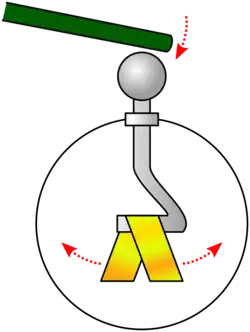
An instrument for detecting net charges, the الکتروسکوپ.
مولتیمتر, combines the functions of ammeter, voltmeter and ohmmeter as a minimum.
السیآر متر, combines the functions of ohmeter, capacitance meter and inductance meter. Also called component bridge due to the bridge circuit method of measurement.
دما-related considerations dominate thermodynamics. There are two distinct thermal properties: A thermal potential — the temperature. For example: A glowing coal has a different thermal quality than a non-glowing one.
And a substance-like property, — the انتروپی; for example: One glowing coal won't heat a pot of water, but a hundred will.
Energy in thermodynamics is calculated by multipying the thermal potential by the amount of entropy found at that potential: temperature times entropy.
Entropy can be created by friction but not annihilated.
A physical quantity introduced in شیمی; usually determined indirectly. If mass and substance type of the sample are known, then جرم اتمی- or وزن مولکولیes (taken from a جدول تناوبی (استاندارد), masses measured by طیفسنجی جرمی) give direct access to the value of the amount of substance. See also the article about جرم مولیes. If specific molar values are given, then the amount of substance of a given sample may be determined by measuring volume, mass or concentration. See also the subsection below about the measurement of the boiling point.
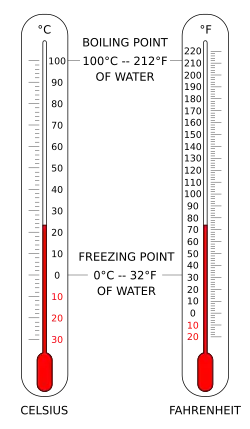
Pyrometers principle: temperature dependence of spectral intensity of light (قانون پلانک), i.e. the color of the light relates to the temperature of its source, range: from about −50°C to +4000°C, note: measurement of پرتو (instead of رسانش گرمایی, or همرفت) means: no physical contact becomes necessary in temperature measurement (pyrometry). Also note: thermal space resolution (images) found in دمانگاری.
حسگر لمسی principle: relation between temperature and electrical resistance of metals (platinum) (مقاومت الکتریکی), range: 10 to 1,000 kelvins, application in physics and industry
solid thermometer principle: relation between temperature and length of a solid (ضریب انبساط گرمایی).
Bi-metallic strip
ترمیستورs principle: relation between temperature and electrical resistance of ceramics or polymers, range: from about 0.01 to 2,000 kelvins (−273.14 to 1,700°C)
ترموکوپلs principle: relation between temperature and voltage of metal junctions (اثر ترموالکتریک), range: from about −200°C to +1350°C
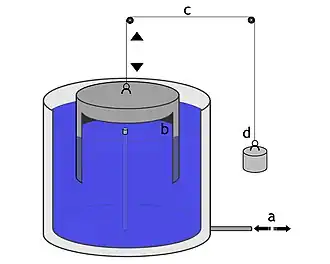
An active کالریمتر lacking a temperature measurement device.
This includes thermal capacitance or temperature coefficient of energy, reaction energy, انتقال گرما...
Calorimeters are called passive if gauged to measure emerging energy carried by entropy, for example from chemical reactions. Calorimeters are called active or heated if they heat the sample, or reformulated: if they are gauged to fill the sample with a defined amount of entropy.
Actinometer measures the heating power of radiation.
constant-temperature calorimeter, phase change calorimeter for example an ice calorimeter or any other calorimeter observing a phase change or using a gauged phase change for heat measurement.
Ebullioscope a device for measuring the boiling point of a liquid. This device is also part of a method that uses the effect of نقطه جوش افزایشی for calculating the وزن مولکولی of a حلال (شیمی).
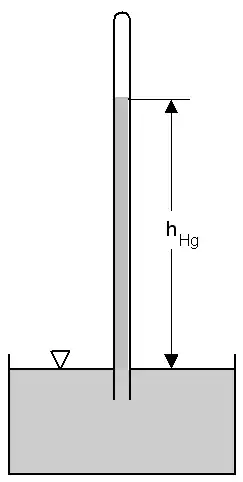
This includes mostly instruments which measure macroscopic properties of matter: In the fields of فیزیک حالت جامد; in فیزیک ماده چگال which considers جامدs, مایعs and in-betweens exhibiting for example viscoelastic behavior. Furthermore مکانیک شارهها, where liquids, گازes, پلاسما (فیزیک) and in-betweens like supercritical fluids are studied.
resonant frequency and Damping Analyser (RFDA), using the impulse excitation technique: A small mechanical impulse causes the sample to vibrate. The vibration depends on elastic properties, density, geometry and inner structures (lattice or fissures).
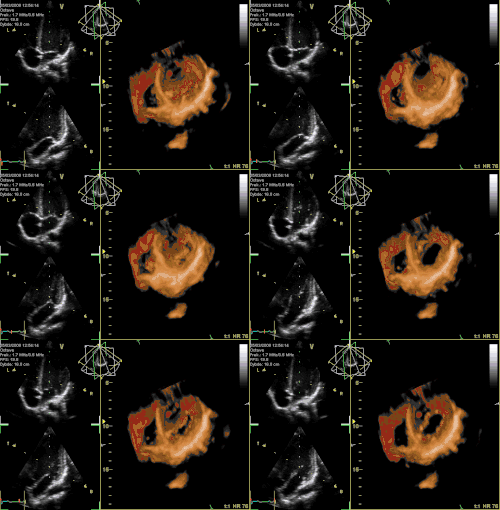
Tomograph, device and method for non-destructive analysis of multiple measurements done on a geometric object, for producing 2- or 3-dimensional images, representing the inner structure of that geometric object.
Substance potential یا chemical potential یا مولار انرژی آزاد گیبس
فاز (ماده) conversions like changes of فازهای ماده, واکنش شیمیاییs or واکنش هستهایs transmuting substances, from واکنشگر نابs to محصول (شیمی), or پخش (فیزیک) through membranes have an overall energy balance. Especially at constant pressure and constant temperature molar energy balances define the notion of a substance potential or chemical potential or molar انرژی آزاد گیبس, which gives the energetic information about whether the process is possible or not - in a closed system.
Energy balances that include entropy consist of two parts: A balance that accounts for the changed entropy content of the substances. And another one that accounts for the energy freed or taken by that reaction itself, the انرژی آزاد گیبس change. The sum of reaction energy and energy associated to the change of entropy content is also called آنتالپی. Often the whole enthalpy is carried by entropy and thus measurable calorimetrically.
For standard conditions in chemical reactions either molar entropy content and molar Gibbs energy with respect to some chosen zero point are tabulated. Or molar entropy content and molar enthalpy with respect to some chosen zero are tabulated. (See آنتالپی استاندارد تشکیل and Standard molar entropy)
An X-ray tube, a sample پراکندگی the پرتو ایکسs and a photographic plate to detect them. This constellation forms the scattering instrument used by پراش اشعه ایکس for investigating crystal structures of samples. جامد آمورفs lack a distinct pattern and are identifyable thereby.
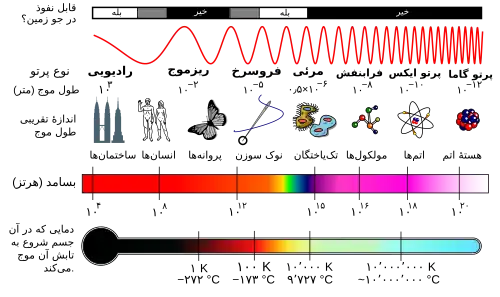
Ionizing radiation includes rays of "particles" as well as rays of "waves". Especially پرتو ایکسs and پرتو گاماs transfer enough energy in non-thermal, (single) collision processes to separate electron(s) from an atom.
This could include مواد شیمیاییs, rays of any kind, ذرات بنیادیs, quasiparticles. Many measurement devices outside this section may be used or at least become part of an identification process.
For identification and content concerning chemical substances see also شیمی تجزیه especially its List of chemical analysis methods and the فهرست روشهای آنالیز مواد.
توموگراف، ابزار یا روشی است برای تجزیه تحلیل غیر مخرب اندازهگیریهای انجام شده بر روی جسم هندسی برای تولید تصویر دو یا سه بعدی که نمایانگر ساختار درونی آن جسم باشد.
در ابزارهای نظامی تعدادی از ابزارها مانند تلسکوپ و ابزارهای ناوبری دریایی سدههای متوالی مورد استفاده بودهاست استفاده از ابزارها با پیشرفت تکنولوژی از سده ۱۹ تا به امروز رواج بیشتری نسبت به گذشته داشتهاست.
ابزارهای نظامی در این مقاله در دستهبندیهای موقعیتیابی، نجومی، نورسنجی، تصویرنگاری و تشخیص مسیر حرکت اجسام و وسایل متحرک قرار گرفتهاند.
مشخصه ویژه آنها دارا بودن سرعت، کاربردپذیری، قابل اعتماد بودن و دقت است.
ابزارهای دستهبندی نشده
Checkweigher measures precise weight of items in a conveyor line, rejecting under or overweight objects.
غلظتسنج measures light transmission through processed فیلم عکاسی or transparent material or light reflection from a reflective material.
Gauge (engineering) A highly precise measurement instrument, also usable to کالیبراسیون other instruments of the same kind. Often found in conjunction with defining or applying استاندارد.
Gradiometer any device that measures spatial variations of a کمیت فیزیکی. For example as done in gravity gradiometry.
پارکومتر measures time a vehicle is parked at a particular spot, usually with a fee.
Postage meter measures postage used from a prepaid account.
S meter measures the signal strength processed by a communications receiver.
حسگر, hypernym for devices that measure with little interaction, typically used in technical applications.